What happens when the curriculum/lesson moves forward, but the child is still trying to catch up?

We spend a great deal of time talking about what children should learn. Curriculum documents tell us what should be taught, what children are expected to know and, in many cases, what they should be able to demonstrate at different stages of their education.
That matters. But to understand it properly, it helps to start from the beginning. As curriculum theorist William Pinar points out, the word ‘curriculum’ actually comes from a Latin term meaning ‘to run a course’ or ‘a track’, pointing to a clear path moving toward a goal. Building on this, education expert A.V. Kelly explains that a true curriculum is never just a simple textbook or syllabus. Instead, it covers everything from the subjects taught and how teachers explain them to the general vibe and daily experiences a student has at school. At the end of the day, it is simply the full map of a child’s learning journey.
But what happens when the lesson moves forward, but the child is still trying to understand what came before? And what happens when an entire classroom contains children who are at very different levels of learning?
These are not small questions. Nigeria has a formal basic education curriculum covering the primary and junior secondary years. The point isn’t to criticise the existence of a curriculum. Please, that’s never my intention in writing this post because “every education system needs one.” The question is whether the system around the curriculum can respond when children are learning at different levels.
Looking at Nigeria’s learning data shows why these factors matter. UNICEF’s analysis of Nigeria’s foundational learning data in 2025, for instance, shows that 73% of children aged 7–14 lack basic reading skills, 75% lack foundational numeracy, and an alarming 70% learning poverty rate means 7 out of 10 children under ten cannot read or understand a simple sentence. Yet UNICEF explicitly notes that the North-West is the hardest, where foundational literacy drops to 9.4% while functional literacy for children finishing Grade 5 reaches 89% in places like Lagos. UNICEF Foundational Literacy and Numeracy report in Nigeria
At the same time, classrooms are buckling under pressure, facing a 37% shortage of physical spaces that pushes primary school learner-to-classroom ratios up to 1:65, alongside the reality that 27% of active primary school teachers are formally unqualified. (UNICEF Global)
Then it changes the question from “Why are children performing poorly?” or “Is the curriculum good enough?” It becomes, “What happens to a child who continues progressing through the education system while still carrying an earlier learning gap?“ Or, in simpler words, “Can the education system meet every child where they are?”
Because a child who is struggling with reading does not necessarily need another layer of content.
- They may need time.
- They may need different instruction.
- They may need targeted support.
- They may need a teacher who knows exactly what they can and cannot yet do.
UNICEF’s work in Nigeria on Teaching at the Right Level offers an interesting example. “Instead of grouping children only by age or class, the approach assesses their learning levels and groups instruction accordingly.” UNICEF reports that similar approaches have been used with SUBEBs to strengthen foundational literacy and numeracy. (UNICEF Global)
To understand the scale of what is expected, it helps to look at what the Nigerian basic education curriculum actually covers on paper. Designed by the Nigerian Educational Research and Development Council (NERDC) under the oversight of the Federal Ministry of Education, the 9-year Basic Education Curriculum (spanning Primary 1 to Junior Secondary School 3) lays out a comprehensive road map. It mandates core subjects like English Studies, Mathematics, Basic Science, and Nigerian Languages, alongside National Values and digital or vocational skills. State Universal Basic Education Boards (SUBEBs) then work to deliver this curriculum across public schools nationwide.
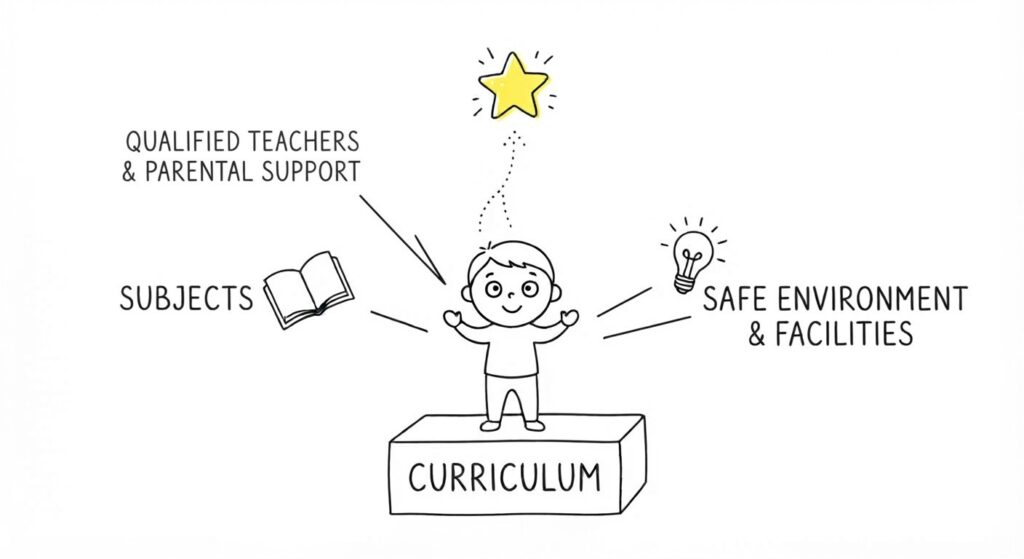
Curriculum is the foundation of quality education, and now in Nigeria, on paper, it is structured to give every child a broad, well-rounded foundation. But this raises an important question:
Does our curriculum serve children who are learning at very different levels?
A teacher may have children who:
- read confidently
- recognise words but struggle with comprehension
- are still struggling with basic decoding
- have gaps in numeracy
- need additional support
The curriculum may be the same.
The children are not.
So the question becomes: How much flexibility does the system give teachers to respond to that difference?
Contextualised learning and teacher capacity are important challenges in the learning crisis. So when we say, “The child is behind,” we have to be careful.
Behind whom? And why? Because a child does not enter the classroom with identical circumstances, prior opportunities or learning experiences.
SO, WHAT SHOULD CHANGE?
- We need to measure where children actually are. Not only whether they have moved to the next grade. If a child is struggling with foundational reading or numeracy, that gap needs to become visible early.
- Foundational learning needs to remain a priority. Moving through the curriculum should not mean moving away from unfinished foundational learning.
- Assessment should inform teaching. Assessment should help answer: What does this child know? How can they practise this outside of the four walls of school too? What are they struggling with? What should we teach next? Did this child pass?
- Teachers need practical ways to respond to different learning levels. Child-centred education sounds good in principle, but teachers need the training, time, resources and classroom approaches that make differentiated learning possible.
- The system needs mechanisms for children to catch up. A learning gap identified in Primary 3 should not still be waiting for a solution in JSS2. Nigeria is already implementing foundational learning and remedial approaches in different contexts. The challenge is learning from what works and strengthening the systems that allow children to receive support when they need it.
- We should evaluate the curriculum by what children actually learn. And this, I think, could be our strongest change: not “Did we cover the curriculum?” but “Did children learn?” Because this shifts our measure toward real impact, comprehension, understanding, and applying what was taught.
In conclusion,
Perhaps we don’t need to abandon the curriculum. We need to stop treating the curriculum as the only measure of whether education is working. A curriculum tells us where we expect children to go. Evidence tells us where they actually are. And good education has to pay attention to both. So if a child is struggling, the answer cannot simply be to keep moving forward because the curriculum says it is time to move forward.
Child-centred education means knowing where the child is, understanding what they need, and creating a path that helps them move forward. The curriculum matters. But the child comes first.
References:
- Kelly, A. V. (2009). The Curriculum: Theory and Practice (6th ed.). London: Sage Publications Ltd.
- Pinar, W. F. (2012). What is Curriculum Theory? (2nd ed.). New York: Routledge.